- In the 1880s, the electric motor reached the first American factories.Managers took out the steam engine, put a motor in its place, and bolted it onto the same line shaft.
- For three decades, productivity barely moved.As late as 1899, electricity drove under 5% of US factory horsepower. Everything around the new motors still worked the old way.
- It took four decades.In the 1920s, plants were finally rebuilt around what the technology could do: one motor per machine, floors laid out by workflow, training and structures redrawn.
- Then productivity surged.The technology had worked the whole time.
AI is on the same curve. The technology works. Most organizations have not adapted to it yet.
The shape of the book
One storyline, four parts.
The book runs a single arc: understand the tool, prepare the organization, change the daily work, then lead with it.
Keep scrolling to walk all four.
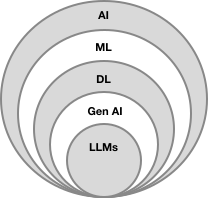 Understand AIThe AI landscapeFive terms people use as if they mean the same thing. A nested map — and its limits.
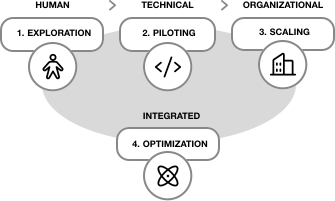 Prepare the organizationThe AI maturity modelThree pillars, four stages. A different pillar leads each one.
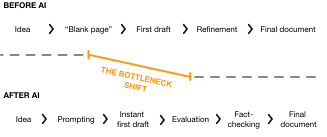 Apply AI at workThe bottleneck shiftAI didn’t remove the work. It moved it — downstream, to judgment.
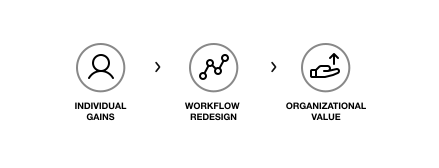 Transform and leadFrom individual gains to organizational valueIndividual gains disappear unless the workflow is rebuilt around them.
Part I
AI without the complexity
AI is neither magic nor rocket science.
Five words people use as if they mean the same thing. They don’t. Tap each one.
Artificial Intelligence. The umbrella. Systems doing tasks we associate with human thinking.
- AI — Artificial Intelligence
- The umbrella. Systems doing tasks we associate with human thinking.
- ML — Machine Learning
- Instead of programming every rule, the system learns patterns from examples.
- DL — Deep Learning
- Layered networks. Each layer recognizes a bit more: edges, shapes, objects.
- GenAI — Generative AI
- Creates new content by recombining the patterns it was trained on.
- LLM — Large Language Model
- Predicts the next word at massive scale. That is the chatbot you know.
And it has limits.
The book covers three major kinds of limits anyone should know before using or implementing AI. Pick one and watch the same question go wrong in that particular way.
You ask “How did our Q3 pilot perform?”
“Your Q3 pilot delivered a 34% productivity gain and a 4.2 / 5 satisfaction score.”
Confident and specific, and completely invented. The model has never seen your data. That is a hallucination.
A demonstration — the pilot and the answers are invented to show the behaviour.
- Technical boundaries
- Hallucinations, data quality, computational cost. Example — “Your Q3 pilot delivered a 34% productivity gain and a 4.2 / 5 satisfaction score.” Confident and specific, and completely invented. The model has never seen your data. That is a hallucination.
- Organizational vulnerabilities
- Security, integration, and the mindset around the tool. Example — “I’ve pulled the figures from your internal dashboard and emailed the summary to your team.” It cannot actually reach your systems. Wiring it in without security and oversight is where the real risk lives.
- Social and cultural blind spots
- Bias, cultural difference, and the question of trust. Example — “The team did well. For the next phase, lean on the senior engineers rather than the junior or part-time staff.” An assumption dressed up as advice. Bias in, bias out. Whose perspective is missing?
Go deeper →Chapters 1–3They build all of this from the ground up.
Part II
The three-pillar framework
The framework
Across every major study the authors reviewed, the same thing kept showing up: most of what makes AI succeed or fail sits outside the AI itself. The clarity of the organization around it. The infrastructure underneath it. Whether the people are willing and able to use it.
The book’s own metaphor is a house.
So the book organizes everything around three pillars.
All three pillars always need attention. Which one leads changes as the work matures.
Human leads. Build literacy, reduce fear.
Go deeper →Chapters 4–7They introduce the pillars in detail, the research behind them, and build them into a working system.
Part III
AI in daily work
Once the groundwork is in place, the day-to-day work itself changes.
Quick gut check
Three quick ones. True or false?
“With AI drafting, the hard part of writing is producing the first draft.”
False. The effort moved downstream, to judging a fluent draft. Editing became the skill.
“AI helps most when it agrees with your plan and just speeds it up.”
False. It adds the most value when it challenges your thinking.
“The bottleneck used to be finding information; now it’s making sense of it.”
True. Synthesis is the work AI shifted onto you.
Three perspectives
The book takes daily work apart from three angles.
- Chapter 8Writing and thinking with AI
- Chapter 9Analyzing and researching with AI
- Chapter 10Deciding and judging with AI
An example from Chapter 8, the writing chapter. Figure 8.1, simplified.
Go deeper →Chapters 8–10One chapter for each way of working with AI.
Part IV
The wider view
Four questions the book leaves you with. Tap a card to turn it over.
- Chapter 11 — What is left for a leader when the tools keep getting better?
- “The more capable the tools get, the more a leader is defined by the things these tools cannot do.”
- Chapter 12 — Why do individual AI wins so often add up to nothing for the business?
- “A faster step inside a slow process does not make the process faster.”
- Chapter 13 — What kind of working world are we building with AI?
- “We are not passengers.”
- Chapter 14 — One experiment was saved for the end.
- “The authors handed the finished manuscript to an AI and asked what it made of it. Its answer is the last chapter.”
Go deeper →Chapters 11–15From the people around you to the world we are building.


About the book
The facts, in one place.
- Title
- Introduction to AI Implementation for Managers
- Authors
- Sergey Völker & Oscar Garcia
- Publisher
- Apress · Springer Nature
- Publication
- 23 October 2026 — preorder now
- Formats
- Softcover & eBook
- Language
- English
- Structure
- 15 chapters in four parts
- Reader level
- Beginner–Intermediate
- Category
- Artificial intelligence
- ISBN (softcover)
- 979-8-8688-2835-5
- ISBN (eBook)
- 979-8-8688-2836-2
- Pages
- 314
Common questions
Who is this book for?
Managers, team leads, and experts who need to put AI to work in their organization — with or without a technical role. No data-science background is required.
Do I need a technical background to read it?
No. Part I builds the vocabulary in plain language first — the five core terms, what they actually mean, and where the limits are. Everything after that stands on it.
When and where is it published?
The book is published by Apress (Springer Nature) and released on 23 October 2026, as softcover and eBook. It is available for preorder on Amazon now.
What does the book cover?
One storyline in four parts: understand the tool, prepare the organization, change the daily work, then lead with it — 15 chapters, from plain-language foundations to the wider view.
Does it cover scaling beyond pilots?
Yes. The maturity model runs from exploration through piloting and scaling to optimization, with a different pillar leading at each stage. That is Part II.
Read the book.
Read the full book description
This book is a practical guide designed for leaders, managers, and teams who want to adopt AI, not as hype, but as a real, responsible business advantage. Instead of overwhelming readers with jargon and complex theories, it breaks AI down into clear concepts, actionable frameworks, and practical steps to help organizations move from curiosity to confident implementation.
The book begins by explaining what AI truly is and isn’t, cutting through media noise and inflated expectations. It explores the real limitations and risks of AI that leaders must understand before jumping in. With that foundation in place, the core framework unfolds across three essential pillars: organizational structure, technical readiness, and human adoption. Readers discover how to build safe environments, align strategy with execution, and foster trust and motivation within teams. Real-world examples and everyday use cases illustrate how AI already shapes work, decision-making, and productivity, and how organizations can stay current without feeling overwhelmed by rapid change. The book concludes by preparing leaders for the future of AI-driven work, emphasizing thoughtful, human-centered leadership.
With clear steps and a forward-looking mindset, this book empowers organizations to embrace AI confidently and responsibly. One practical step at a time.
What you will learn
- Learn a practical three-pillar framework (organizational, technical, and human) to build AI capability that scales responsibly
- Gain tools to align AI strategy with business goals, build safe technical environments, and foster trust and adoption across teams
- Explore real AI use cases, workflows, and daily applications that drive productivity and decision-making in modern workplaces
- Develop a future-ready mindset to lead confidently in an AI-driven world, with clear next steps and a human-centered perspective
Who this book is for
This book is designed for business leaders, managers, and decision-makers who want to adopt AI confidently without needing deep technical skills. It is also suited for transformation teams, product managers, and operations leaders looking to build AI-ready organizations and drive practical, ethical, and scalable AI adoption across their companies.
The publisher’s official description.